
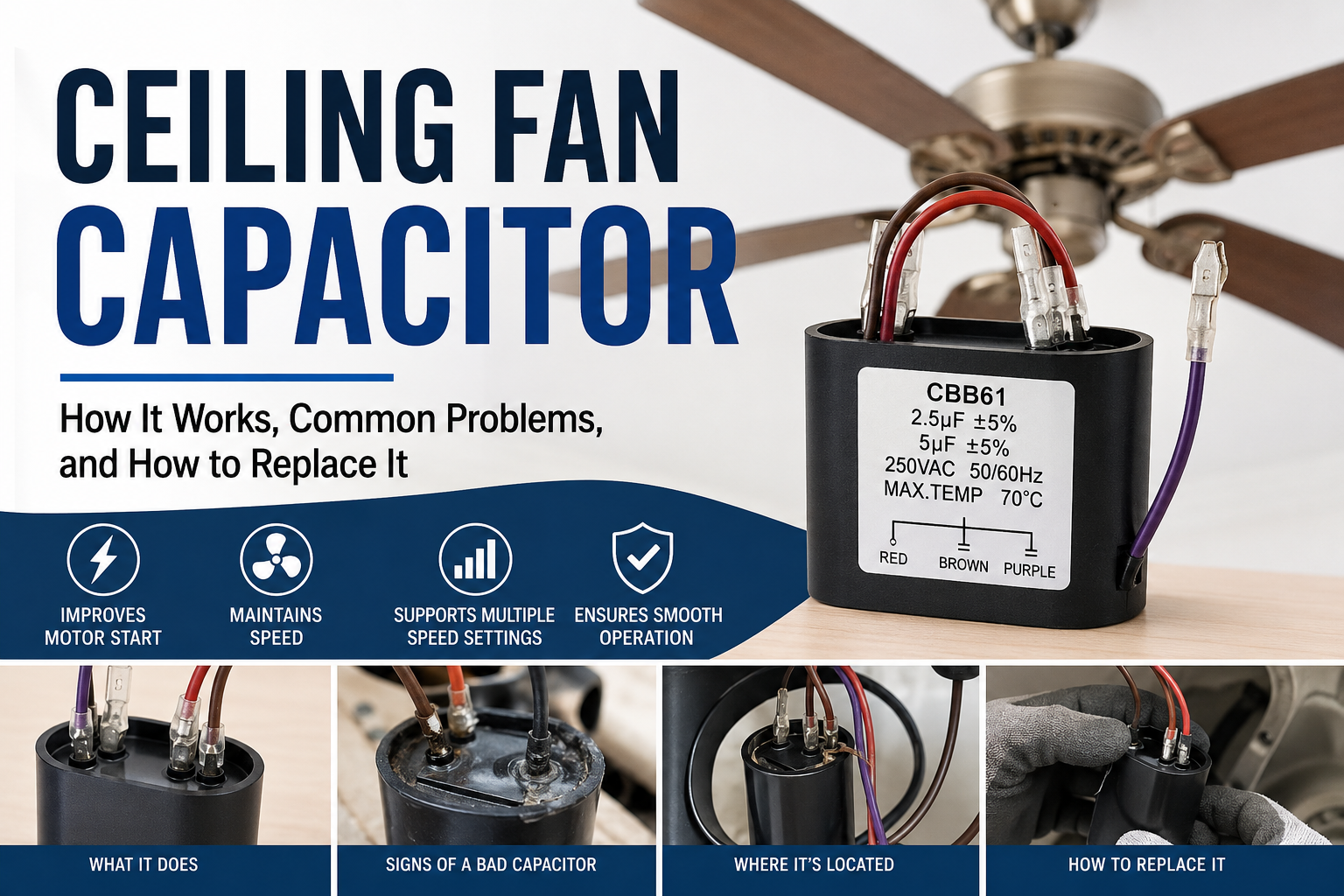
A ceiling fan is one of the simplest and most useful appliances for keeping a room comfortable. It circulates air, improves ventilation, and can help reduce the need for air conditioning. However, when a ceiling fan suddenly becomes slow, struggles to start, or stops working properly, one small component is often responsible: the ceiling fan capacitor.
The capacitor plays an important role in controlling the motor’s performance. Although it is a relatively small electrical component, a faulty capacitor can cause noticeable problems with your fan. Understanding what a ceiling fan capacitor does, how to recognize a bad one, and when it should be replaced can help you troubleshoot common fan problems.
What Is a Ceiling Fan Capacitor?
A ceiling fan capacitor is an electrical component that stores and releases electrical energy to help the fan motor operate correctly. Most household ceiling fans use single-phase AC motors, which require a phase difference between their windings to produce the rotating magnetic field needed to turn the motor.
The capacitor helps create this phase shift. As a result, the motor can start rotating and maintain the appropriate speed.
In many ceiling fans, the capacitor is also involved in controlling multiple speed settings. A fan with low, medium, and high settings may use different capacitance values or combinations of capacitors to change the motor’s operating characteristics.
Simply put, the capacitor helps your ceiling fan motor start, run, and operate at different speeds.
Why Is the Capacitor Important?
Without a properly functioning capacitor, a ceiling fan motor may not receive the electrical conditions it needs to operate efficiently.
A healthy capacitor can help the motor:
- Start rotating properly
- Maintain its designed operating speed
- Run more efficiently
- Support different fan-speed settings
- Operate smoothly
When the capacitor begins to fail, the fan may still receive electricity, but the motor may not behave normally. This is why a ceiling fan that has power but rotates very slowly may have a capacitor problem.
Signs of a Bad Ceiling Fan Capacitor
A faulty capacitor can produce several recognizable symptoms. While these symptoms can sometimes be caused by other electrical or mechanical problems, the capacitor is one of the first components worth checking.
1. The Fan Runs Slowly
One of the most common symptoms is reduced fan speed. You may notice that the fan spins, but even at the highest setting, it does not move as much air as it used to.
A capacitor that has lost part of its capacitance may prevent the motor from reaching its normal speed.
2. The Fan Has Trouble Starting
Another common warning sign is a fan that hums but does not start spinning on its own.
In some cases, manually pushing the blades can cause the fan to begin rotating. This behavior can indicate a capacitor problem, although mechanical or motor faults can produce similar symptoms.
3. Some Speed Settings Stop Working
If your ceiling fan has multiple speeds and one or more settings no longer work correctly, the capacitor may be damaged.
For example, the fan might run on high but barely move on low, or one speed may stop working entirely. Since fan-speed control can involve capacitor sections, a defective capacitor can affect individual settings.
4. The Fan Changes Speed Unexpectedly
A failing capacitor may cause inconsistent operation. The fan could appear to speed up and slow down without changing the control setting.
However, fluctuating speed can also be caused by a faulty speed controller, loose wiring, or motor problems, so the capacitor should not automatically be blamed.
5. The Capacitor Shows Physical Damage
Sometimes the capacitor itself provides a visual clue. A damaged component may appear swollen, cracked, leaking, or burned.
If you see obvious physical damage, the capacitor should be replaced rather than reused.
What Causes a Ceiling Fan Capacitor to Fail?
Capacitors can eventually deteriorate because of age, heat, electrical stress, and normal wear.
Common causes include:
- Long-term use
- Excessive heat
- Voltage fluctuations
- Poor-quality components
- Electrical surges
- Internal deterioration
- Manufacturing defects
Ceiling fans can operate for many years, but their capacitors may not last as long as the motor itself. This means a fan that has worked reliably for years may eventually develop capacitor-related problems.
How to Choose the Correct Ceiling Fan Capacitor
Replacing a capacitor is not simply a matter of buying any capacitor that looks similar. The replacement must have specifications appropriate for the fan.
The most important specification is capacitance, which is measured in microfarads (µF or MFD).
You may see a capacitor labeled with values such as:
2.5 µF + 2.5 µF + 5 µF
The exact arrangement varies by fan design.
When replacing a capacitor, check the original component carefully. Look for the capacitance values and the voltage rating printed on its body. The replacement should be compatible with the manufacturer’s specifications.
If you are unsure about the correct replacement, check the fan’s documentation or consult a qualified electrician or appliance technician.
Understanding Capacitance and Voltage Ratings
Two specifications are particularly important when choosing a ceiling fan capacitor: capacitance and voltage rating.
Capacitance
Capacitance determines how much electrical charge the component can store under specified conditions. In ceiling fans, the correct capacitance is important because it affects motor operation and speed.
Using an incorrect capacitance value can cause the fan to perform poorly or may place unnecessary stress on the motor.
Voltage Rating
The voltage rating indicates the maximum voltage the capacitor is designed to withstand under its specified conditions.
A replacement capacitor should have a voltage rating suitable for the fan’s electrical system. Never assume that a physically similar capacitor is automatically safe to use.
How to Replace a Ceiling Fan Capacitor
Replacing a ceiling fan capacitor involves working with electrical wiring, so safety should always come first.
Before doing anything, turn off power to the fan at the circuit breaker, not merely at the wall switch. A wall switch may not eliminate all electrical hazards.
After power is disconnected, verify that the circuit is not energized using an appropriate electrical testing method.
The general replacement process is:
- Turn off the circuit breaker supplying the fan.
- Confirm that power is disconnected.
- Remove the appropriate fan housing or control cover.
- Locate the capacitor.
- Take a photo of the existing wiring before disconnecting anything.
- Record the capacitor’s specifications.
- Disconnect the old capacitor carefully.
- Install a compatible replacement.
- Reconnect the wires exactly according to the original configuration and manufacturer instructions.
- Secure the housing and restore power.
- Test the fan’s speed settings.
Because ceiling fan wiring varies between models, there is no universal wiring arrangement. If the wiring is confusing, damaged, or different from the documentation, it is safer to have a qualified professional perform the replacement.
Can a Ceiling Fan Run Without a Capacitor?
A typical capacitor-run ceiling fan motor is designed to operate with its specified capacitor. Removing or bypassing the capacitor is not a proper repair.
The capacitor contributes to the motor’s intended electrical operation. Without it, the fan may fail to start, run incorrectly, overheat, or suffer motor damage.
For this reason, you should not attempt to eliminate the capacitor simply because the fan is not working.
Ceiling Fan Capacitor vs. Motor Problem
Not every slow or non-working ceiling fan has a bad capacitor.
Other possible causes include:
- Dirty or obstructed bearings
- A damaged motor
- Faulty wiring
- A defective speed controller
- Loose electrical connections
- A faulty wall switch
- Problems with the remote-control receiver
- Mechanical resistance in the fan assembly
If replacing the capacitor does not solve the problem, further diagnosis may be necessary.
A professional can test the capacitor and other electrical components using appropriate equipment.
How Much Does a Ceiling Fan Capacitor Cost?
The cost of a replacement ceiling fan capacitor is generally modest compared with replacing the entire ceiling fan. However, prices vary depending on capacitance values, voltage rating, brand, construction, and whether the part is sold individually or as part of a repair kit.
Although it may be tempting to choose the cheapest available component, compatibility and quality are more important than price alone.
A properly rated replacement from a reputable manufacturer can provide more reliable performance.
How to Make Your Ceiling Fan Last Longer
Proper maintenance can help reduce stress on the fan motor and other components.
Keep the fan blades clean because accumulated dust can affect balance and airflow. Make sure the fan is securely mounted and does not wobble excessively. If your model requires lubrication, follow the manufacturer’s instructions.
You should also pay attention to unusual sounds, burning smells, excessive heat, or sudden changes in performance. Addressing problems early can prevent a minor issue from becoming a larger electrical or mechanical problem.
Avoid overloading electrical circuits and have questionable wiring inspected by a qualified professional.
Frequently Asked Questions
What does a ceiling fan capacitor do?
A ceiling fan capacitor helps create the electrical phase relationship needed for the motor to start and operate. In many fans, it also contributes to different speed settings.
How do I know if my ceiling fan capacitor is bad?
Common signs include slow operation, difficulty starting, unusual speed behavior, or certain speed settings not working. A proper electrical test can provide a more reliable diagnosis.
Can I replace a ceiling fan capacitor myself?
Some people with appropriate electrical knowledge and tools can replace one, but ceiling fans contain electrical wiring that can be hazardous. Always disconnect power at the circuit breaker and follow the manufacturer’s instructions. When in doubt, hire a qualified electrician.
Does a higher capacitor value make a fan faster?
Not necessarily. A capacitor is part of a motor’s designed electrical system, and simply installing a higher capacitance value is not a safe or reliable way to increase fan speed. Use the manufacturer’s specified value.
How long does a ceiling fan capacitor last?
There is no single lifespan that applies to every capacitor. Service life depends on component quality, operating temperature, electrical conditions, and usage. A capacitor may eventually deteriorate even when the fan motor remains functional.
Final Thoughts
The ceiling fan capacitor may be a small component, but it has an important role in the operation of many household ceiling fans. It helps the motor start and run properly and can also be involved in controlling different fan speeds.
When a fan becomes unusually slow, struggles to start, or develops problems with its speed settings, the capacitor is one possible cause. However, similar symptoms can result from wiring, motor, controller, or mechanical problems.
If you decide to replace a capacitor, always use a compatible component with the correct specifications and follow the manufacturer’s instructions. Because ceiling fans are connected to household electrical power, safety should be the top priority.
Understanding how a ceiling fan capacitor works makes it easier to recognize common problems and decide whether a simple component replacement may solve the issue or whether professional electrical service is needed.